DRC process proof
See Two Crushing Stages Combined in One Double Roll Crusher
To play this video, allow YouTube in the privacy settings or watch on YouTube ↗.

Industrial roll crusher guide
A roll crusher reduces rock, minerals and recyclable material between one rotating roll and a breaker wall or between two counter-rotating rolls. The right arrangement, roll surface and gap depend on the feed, target product and required throughput—from primary to tertiary crushing.





The right solution for your process requirements
A roll crusher reduces feed material between a rotating roll and a counter surface or between two counter-rotating rolls. The roll geometry, tool profile, speed and crushing gap determine how the material is drawn in, fractured and discharged.
Unlike a one-size-fits-all machine, an industrial roll crusher must be selected around the material, feed size, target size, required capacity and expected foreign objects. Crush + Size combines the crusher, drive, gap adjustment, overload protection and control system into an application-specific process solution.
Controlled crushing
The material follows a clear path through the crusher. Feed enters from above, the rotating roll surfaces draw it toward the nip point, the material is reduced as the available space narrows, and the product leaves below the rolls. Gap, roll surface and speed influence the result; they are settings, not separate steps.
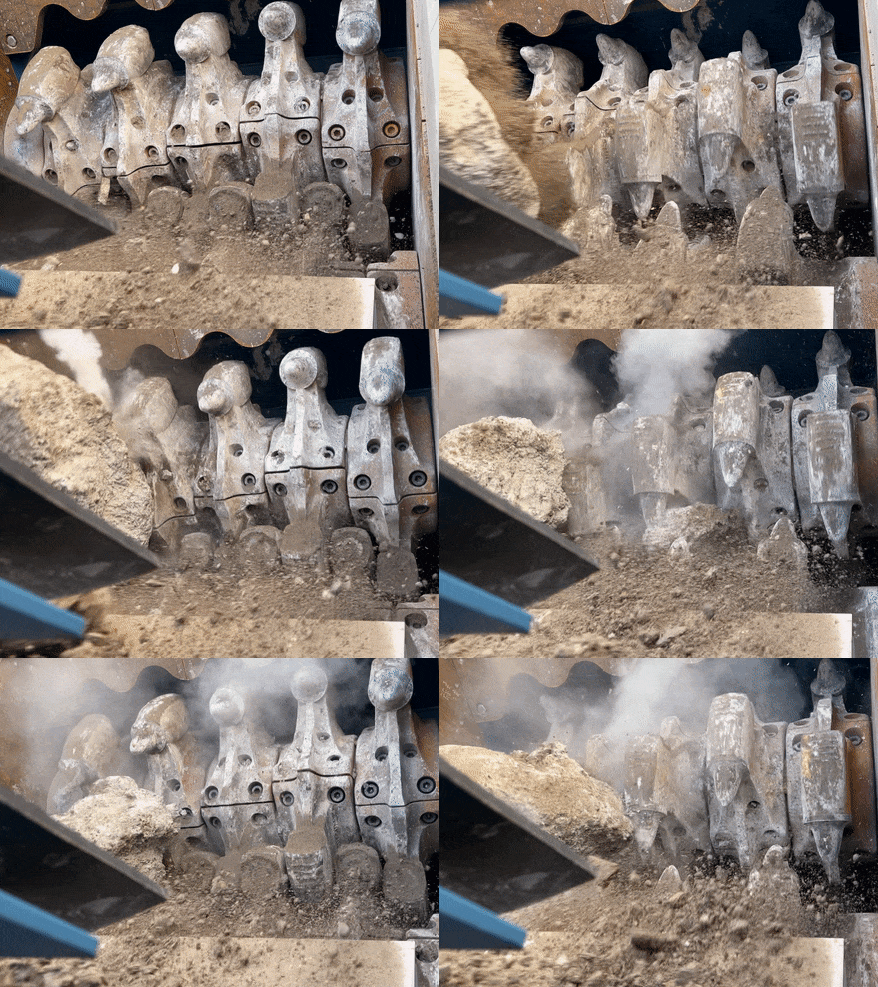
Material is introduced from above and distributed across the available roll width.
Counter-rotating rolls—or one roll and a breaker wall—draw the material toward the nip point.
Compression, shear and localized impact break the feed as the available space narrows toward the crushing gap.
Material small enough to pass the selected gap leaves below the rolls for the next process stage.
Roll crusher types
The roll arrangement determines how many crushing gaps or stages the material passes through. Compare each type by crushing principle, feed fit and output goal; roll surface and tooling are explained separately below.
| Arrangement | Crushing principle | Feed and material fit | Typical output goal | 
|
|---|---|---|---|---|
| Single roll crusher | One driven roll works against a pivoting breaker wall. | Irregular or bulky feed requiring strong positive intake. | High reduction in one controlled crushing stage. | SRC Single Roll Crusher |
| Double roll crusher | Two opposing rolls draw material into an adjustable crushing gap. | Primary to tertiary duties with application-specific tools. | Defined product size, controlled grading curve and limited fines. | DRC Double Roll Crusher |
| Triple roll crusher | Three rolls create two sequential crushing gaps in one arrangement. | Processes that need staged reduction but limited installation space. | A higher overall reduction ratio across two stages. | The DRC Double Roll Crusher combines a high reduction ratio with an adjustable gap. See the documented limestone trial → |
DRC process proof
To play this video, allow YouTube in the privacy settings or watch on YouTube ↗.
Roll surface and tooling
Smooth, profiled and toothed rolls change how the feed is gripped, fractured and discharged. These simplified models show the basic principle; the final tool geometry is engineered around the material and target product.
A continuous roll face applies pressure across the contact zone without pronounced teeth. It suits feed that does not require aggressive gripping.
Typical resultControlled smaller product with a low share of unwanted fines.
Wide ribs or lobes increase the bite on the feed while retaining a more controlled breakage pattern than pronounced teeth.
Typical resultBalanced material intake, particle shape and grading curve.
Pronounced teeth or picks penetrate and draw in larger, irregular or difficult pieces while adding shear to the compressive force.
Typical resultStrong intake and application-specific reduction of coarse feed.
Technology comparison
These machines use different breakage mechanisms. The right choice depends on feed behavior, desired product, fines tolerance, wear conditions and the required reduction ratio.
| Machine concept | Best fit |
|
|---|---|---|
| Roll crusher | Controlled product size, positive intake and limited fines through compression, shear and localized impact. | DRC, SRC, CRC, SGC or ACR, selected around feed, gap, surface and speed. |
| Mineral sizer | Compact, high-capacity sizing with low-speed, toothed, synchronized shafts. | The SZR Sizer combines patented tool geometry with mechanically synchronized rolls to improve intake and grain formation in a compact footprint. Depending on the feed material, reduction ratios up to approximately 1:5 are achievable. |
| Jaw crusher | Coarse primary compression of hard, blocky rock; product shape and fines differ from roll crushing. | The DRC Double Roll Crusher can be engineered for high-performance primary crushing of hard, blocky feed in applications commonly served by jaw crushers. Final selection depends on feed behavior and the required product curve. |
| Impact or hammer crusher | High reduction ratios and fine product generation through high-velocity impact. | The HMM Hammer Mill combines repeated impact stages with adjustable grinding walls for very high reduction and fine grinding. It accepts feed up to 300 mm and can achieve product sizes below 0.063 mm, depending on the material; its reversible rotor extends wear-part service life. |
Crush + Size product families
Choose the product family by process goal, then use the dedicated product page and data sheet to examine the machine in more detail.

Flexible primary-to-tertiary reduction
High-performance primary-to-tertiary crushing with hydraulic gap adjustment and overload protection for changing process duties.

High reduction with positive intake
A driven roll and pivoting breaker wall provide strong intake, high reduction and robust foreign-object protection for bulky feed.

Compact high-capacity sizing
Synchronized rolls and patented tool geometry provide compact, high-capacity sizing for difficult feed, with reduction up to approximately 1:5 depending on material.

Efficient reduction of softer feed
A compact, belt-driven roll crusher for softer to medium-hard feed where efficient, straightforward size reduction is required.

Controlled sand and grit production
Specialized smooth-roll crushing for small target grain, controlled particle shape and limited fines in sand, grit and recycling fractions.
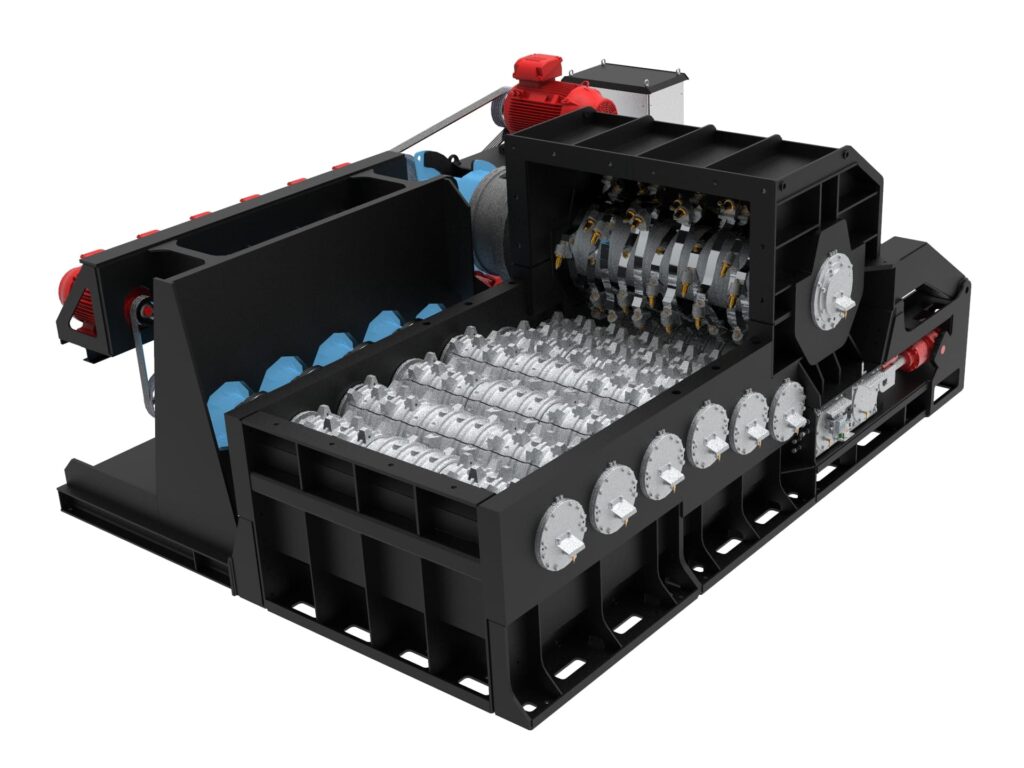
Gentle asphalt size reduction
Integrated material intake, pre-crushing and gentle asphalt size reduction for slabs and blocks into a reusable coarse product.
Application range
Roll crushing is most valuable where feed control, usable product yield and downstream quality matter as much as nominal reduction.
Challenge: Large mineral feed, overburden and load peaks.
Target: Protected intake and defined downstream feed.
Challenge: Preserve valuable coarse fractions while controlling top size.
Target: Stable grading curve with limited fines.
Challenge: Heterogeneous feed and possible foreign objects.
Target: Robust reduction and reusable output.
Challenge: Sticky material can hinder intake.
Target: Reliable draw-in and a defined downstream size, with contamination assessed separately.
Include moisture, clay content and seasonal variation in the application review.
Challenge: Break slabs without unnecessary additional fines.
Target: Reusable coarse asphalt product.
Challenge: Produce smaller target sizes without losing value to excess fines.
Target: High share of usable sand and grit fractions.
Challenge: Strong intake, variable shape and non-crushable objects.
Target: Controlled pre-crushing for the next process stage.
Technical resources
Use the source documents for first orientation. Final throughput, product size and machine configuration require material-specific process assessment.
The page sequence has already taken you from the labeled roll diagram and nip point through the process animation to product-family and application comparisons.
Material, feed size, grading curve, moisture, bulk density, target size, capacity, foreign objects, location and project timeline help define the right configuration.
Discuss your applicationSelection & procurement
Technical fit comes first. These answers also help define a useful quotation, test request and international project scope.
Discuss your requirements →Start with material, maximum feed size, target grading and capacity. Compare the roll arrangements and product families, then check hardness, moisture and operating risks. The broad term “roll crusher” covers several machine concepts; selection is application-specific.
The C+S series shown here are industrial production machines. A laboratory sample-preparation crusher is a different application and should not be selected from these industrial throughput ranges.
Machine size, tooling, drive power, gap adjustment, overload protection, controls and the integration scope affect the quotation. Delivery, installation and service scope also need to be defined. There is no single meaningful price for the full portfolio; prepare a project brief for a specific quotation.
Depending on the series and tooling, both can be viable applications. Material strength, abrasiveness, moisture, clay content and feed geometry must be reviewed together before a machine and tool configuration are selected.
The crushing gap, roll surface, tool geometry, speed and material behavior interact. Specify a grading curve and acceptable fines fraction, not just a nominal gap. The achievable result must be confirmed for the actual feed material.
Depending on the machine, hydraulic or mechanical overload protection allows the gap or breaker wall to yield. Suitable reversing and opening functions can assist blockage clearance. Confirm the required protection and operating procedure for the selected series; these features are not identical across the portfolio.
Include your material, available sample quantity and the result you need to verify in your enquiry. Ask C+S which test or demonstration options are available for that application. Availability, test scope and acceptance criteria need to be agreed with the engineering team.
C+S develops and manufactures in Germany. For an international project, provide the installation country, site access and timeline, then agree transport, commissioning responsibilities, documentation, wear parts and service arrangements in the quotation. Lead times and local service coverage must be confirmed for your site, not inferred from the machine specification.
Your next step
Share your material, feed size, target product and required capacity through the official contact page. The engineering team can then review the appropriate machine and configuration with you.